ROI Measurement Framework for AI Corporate Training
An ROI measurement framework for AI corporate training: baseline metrics, business impact by industry and the L&D report that earns CFO approval fast.
Roleplays Team
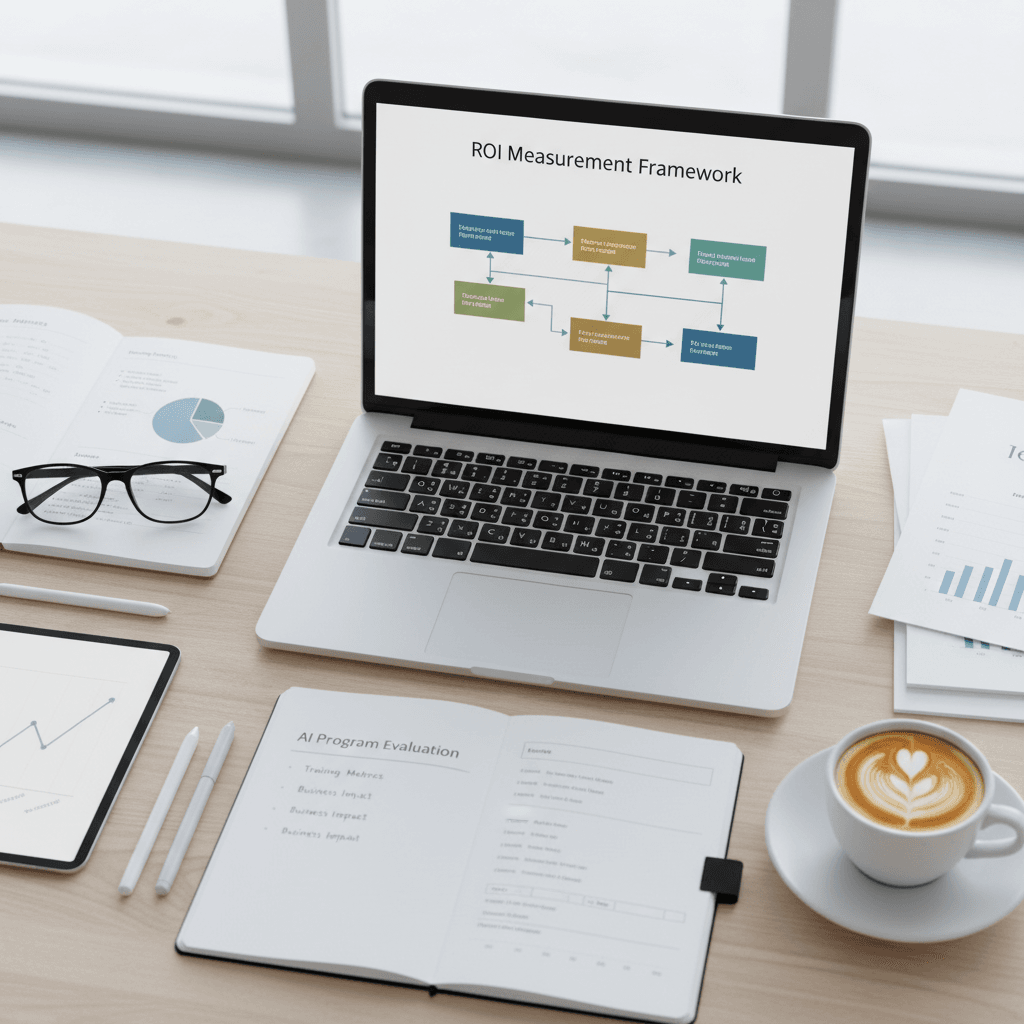
Enterprise Learning and Development leaders face mounting pressure to demonstrate tangible business value from their AI training investments. While traditional training metrics like completion rates and satisfaction scores remain important, they fail to capture the true economic impact of modern AI-powered learning initiatives. This comprehensive framework provides L&D professionals with data-driven methodologies to measure training ROI, quantify performance improvements, and identify cost savings across regulated industries. If you are starting from zero, the primer on how to measure corporate training ROI with AI covers the basic calculation before you scale it into a full framework.
Establishing Baseline Metrics for AI Training ROI
Before implementing any AI training program, establishing robust baseline measurements is crucial for accurate ROI calculation. Traditional corporate training metrics often focus on learning outputs rather than business outcomes, creating a significant gap in understanding actual value creation.
Start by identifying three critical baseline categories: operational performance indicators, compliance metrics, and knowledge retention rates. For operational performance, capture current productivity levels, error rates, and time-to-competency for new hires. In regulated industries, document existing compliance violation frequencies, audit findings, and remediation costs.
Knowledge retention baselines require pre-training assessments that measure not just theoretical understanding but practical application capabilities. Design scenario-based evaluations that mirror real workplace challenges, particularly for safety-critical roles or customer-facing positions where knowledge gaps directly impact business outcomes. The evidence on how much practice-based formats change retention is summarized in AI role-play vs traditional sales training and what the retention data says.
Advanced Analytics for Training Effectiveness Measurement
AI-powered corporate training platforms generate unprecedented volumes of learner interaction data, enabling sophisticated training effectiveness analytics that go far beyond traditional completion tracking. Modern L&D ROI measurement requires leveraging this data to understand learning patterns, identify skill gaps, and predict performance outcomes.
Implement competency progression tracking that maps individual learner journeys against role-specific skill requirements. This approach transforms subjective performance reviews into objective, data-driven assessments. Track micro-learning completions, simulation performance scores, and peer collaboration metrics to build comprehensive learner profiles. The quality of that data depends on the session design itself, and the anatomy of a scored session is laid out in this guide to AI roleplay for corporate training: scenario, persona, rubric, and evidence trail.
“The most successful AI training programs we’ve measured show clear correlation between simulation-based practice frequency and real-world performance improvements, but only when the simulations accurately reflect actual workplace scenarios.” - Chief Learning Officer, Fortune 500 Financial Services Company
Behavioral analytics provide deeper insights into training effectiveness by identifying optimal learning pathways for different employee segments. Analyze completion patterns, help-seeking behaviors, and knowledge application timing to optimize future training delivery and predict which employees may require additional support.
Ready to transform your training measurement approach? See how leading enterprises are leveraging AI-powered simulations to drive measurable business outcomes.
Schedule Your Demo →Quantifying Business Impact Across Regulated Industries
Regulated industries present unique opportunities for AI training ROI measurement due to their stringent compliance requirements and well-documented cost structures for violations. Financial services, healthcare, and manufacturing organizations can leverage regulatory frameworks to create clear connections between training investments and business outcomes.
In financial services, measure training impact through compliance violation reduction, audit preparation efficiency, and customer complaint resolution times. Track the cost avoidance from prevented violations, which often carry substantial monetary penalties and reputation damage. Document improvements in audit readiness scores and the reduction in hours required for compliance preparation activities. Banks that run KYC and AML training as realistic compliance simulations get decision-level data that feeds these calculations directly.
Healthcare organizations should focus on patient safety indicators, medical error reduction, and staff retention rates. AI training programs in healthcare settings often target critical thinking skills, emergency response protocols, and patient communication techniques. Measure outcomes through incident reporting data, patient satisfaction scores, and staff turnover costs.
Manufacturing environments provide clear metrics through safety incident reduction, equipment downtime prevention, and quality control improvements. Track lost-time injury rates, near-miss reporting frequency, and first-pass quality percentages to demonstrate training value in monetary terms. Pharmaceutical plants have an additional lever here, since the documentation demanded by ANVISA GMP training requirements doubles as ROI evidence when audits go smoothly.
Technology Integration for Real-Time ROI Tracking
Modern AI training ROI measurement requires seamless integration between learning management systems, performance management platforms, and business intelligence tools. This technological foundation enables real-time tracking of training effectiveness and business impact correlation.
Implement automated data collection systems that capture performance metrics before, during, and after training interventions. Connect learning platform APIs with HR information systems to track career progression, promotion rates, and retention statistics for trained employees versus control groups.
Develop custom dashboards that translate learning analytics into business language for executive stakeholders. Display metrics like cost-per-competency-gained, time-to-productivity improvements, and revenue-per-trained-employee to communicate training value in terms leadership understands.
Consider predictive analytics capabilities that forecast future performance based on current training completion patterns. These insights enable proactive interventions for at-risk learners and help optimize training resource allocation across different employee segments.
Cost-Benefit Analysis Framework for L&D Investments
Comprehensive corporate training metrics must account for both direct and indirect costs associated with AI-powered learning initiatives. Direct costs include platform licensing, content development, and administrative overhead. Indirect costs encompass employee time away from productive work, technology infrastructure, and ongoing maintenance requirements.
Calculate the total cost of ownership over a three-year period to account for platform scalability, content updates, and integration complexities. Include opportunity costs from alternative training methods and factor in the depreciation of training content in rapidly evolving fields.
On the benefits side, quantify hard savings from reduced error rates, improved efficiency, and decreased compliance violations. Soft benefits include enhanced employee engagement, improved retention rates, and increased internal mobility capabilities. Assign conservative monetary values to soft benefits based on industry benchmarks and historical company data.
Building Executive Buy-In Through Data-Driven Reporting
Executive stakeholders require clear, concise reporting that connects training investments to business outcomes. Develop monthly ROI reports that highlight key performance indicators aligned with organizational strategic objectives. Focus on metrics that directly impact revenue, cost reduction, or risk mitigation.
Create compelling visualization tools that demonstrate training impact trends over time. Show correlation between training completion rates and business performance metrics, while acknowledging external factors that may influence results. Use statistical significance testing to validate training impact claims and build credibility with data-skeptical executives.
Establish regular review cycles with business unit leaders to discuss training effectiveness and gather feedback on skill development needs. This collaborative approach ensures training programs remain aligned with evolving business requirements and maintains executive support for L&D investments.
Measuring AI training ROI requires sophisticated methodologies that go beyond traditional learning metrics to capture true business impact. By implementing comprehensive measurement frameworks, leveraging advanced analytics, and maintaining focus on business outcomes, L&D leaders can demonstrate clear value from their training investments.
Ready to revolutionize your corporate training ROI measurement? Roleplays provides enterprise-grade AI-powered training simulations with built-in analytics capabilities that make measuring business impact straightforward and accurate. Our platform delivers the data-driven insights you need to prove training value and optimize learning outcomes. Contact us today to discover how leading organizations are achieving measurable results with AI training ROI frameworks.
Stay in the loop
Get the latest insights on corporate training delivered to your inbox.