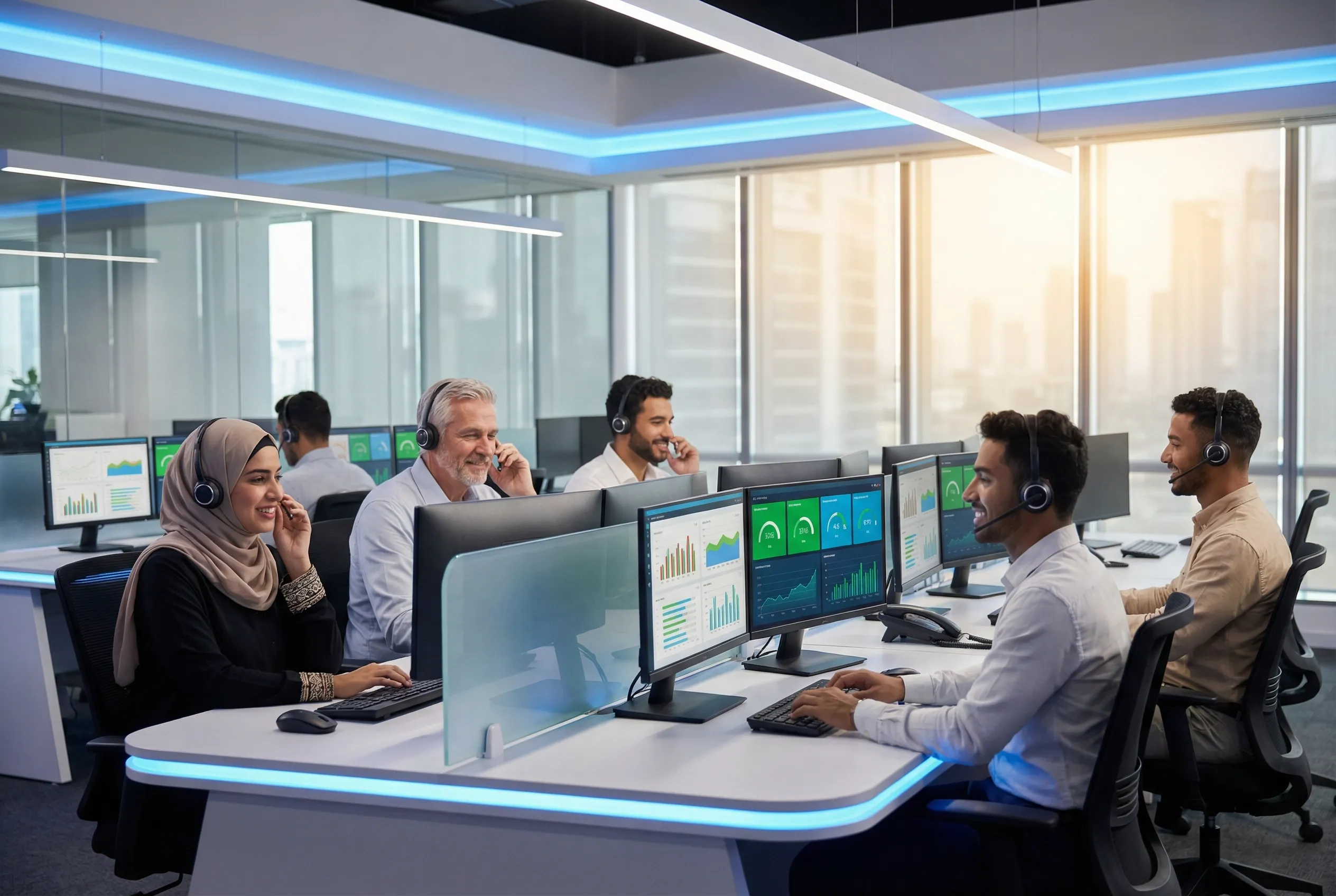
Train 10,000 Operators Without Stopping Operations
AI-powered simulations for call centre, BPO, and multi-vertical contact centre operations (telecoms, banking, insurance, automotive). Cut ramp-up time by up to 60%, move beyond clunky scripted simulators, and scale training across shifts without pulling operators off the floor. Native SSO + LMS integration, mandatory at 10,000+ operator scale.
60%
Reduction in ramp-up time
10K+
Concurrent operators on the platform
24/7
Training available across shifts
100%
Sessions documented and scored
50+
Engagement badges
30+
Languages supported
Real challenges
What blocks training today
What we hear from training leaders in real conversations. No fluff.
10,000-operator operations do not fit in a training room
Most enterprise contact centre operations today, especially in telecoms, run more than 10,000 operators distributed across call centre, retail stores, and field technical teams (repair, installation). Classroom training does not scale to that size, and the empty-seat cost during capability cycles is prohibitive. The solution is to train in 5 to 15-minute micro-sessions through Roleplays, integrated with the corporate LMS via SSO, without removing operators from production.
Clunky scripted simulators frustrate the 18-to-35 generation
The dominant operator profile in contact centres today is young, between 18 and 35, with very low tolerance for the "scripted simulators" that fill the market, static screens with rote scripts and linear flow. They want realistic, conversational practice that prepares them for what they will face in the headset. Roleplays delivers exactly that: voice simulation with generative AI that improvises, pushes back, loses patience, just like a real customer.
BPOs serve multiple verticals, and each account demands its own content
Contact centre BPO companies typically serve 5 to 20 accounts simultaneously (telecoms, banks, insurance, automotive, retail, utilities). Each account demands its own scripts, compliance rules, customer persona, metrics. Keeping training content updated across all accounts is the daily pain of the Organisational Human Development (DHO) area. Roleplays lets you separate templates per client-account, with a dedicated media library per vertical, and reports filtered by end client.
DHO must serve apprentices, interns, and leadership from the same menu
The DHO area of large operations must serve very different profiles: Young Apprentice programmes with initial training, interns rotating across areas, full operators in continuous capability, coordinators in leadership development. Each profile needs its own track. Roleplays offers differentiated Permission Sets, profile-based track assignment, and per-programme evolution reports, serving all these audiences on the same platform.
Culture and brand tone are not trained, they are "learned in the headset"
Contact centre operators must master not only product and process, but the tone of the brand they represent: how a premium telecoms carrier addresses the customer versus a young fintech; how an institutional insurer versus a digital bank. Today, this cultural learning happens "in the headset", in contact with the real customer, with costly mistakes. In Roleplays, brand tone is parametrised in the scenario system prompt, and the AI evaluates every interaction against that specific tone.
30% to 45% annual turnover costs £4,000 per operator
According to QATC (Quality Assurance & Training Connection) research, call centres face annual turnover of 30% to 45%. With an average cost of £3,000 to £5,000 per replacement (recruitment, training, and lost productivity), a 1,000-operator operation can lose more than £1.5 million per year on turnover alone.
In-person training costs £30 to £60 per operator per day of stopped operation
Each day of classroom training is an empty seat. For operations with strict SLAs, pulling 20 operators off the floor per day means hundreds of unanswered calls and a drop in service level. In peak periods like Black Friday or retention campaigns, the cost is even more critical.
Script adherence drops 23% after the first month
Quality monitoring studies show that operators follow protocols strictly in the first weeks, but adherence drops progressively without continuous reinforcement. Mandatory disclosures are skipped, standard greetings are ignored, and PCI procedures are simplified, generating regulatory risk and complaints.
Quality monitoring covers only 1% to 3% of interactions
Most operations evaluate between 1% and 3% of calls by sampling. That means 97% of interactions are not evaluated. Systemic problems, like errors in collections scripts or empathy failures in retention, only get identified after they have already generated complaints, churn, or regulatory penalties.
Retention scenarios demand practice that PowerPoint cannot offer
Handling a cancellation threat demands emotional intelligence, active listening, and real-time negotiation capacity. Research indicates that operators trained with practical simulation have a 35% higher retention rate than those trained only with theoretical material. The difference between retaining and losing a customer is in the practice, not in the reading.
Night and weekend shifts get 70% less training
Alternative shift operators handle the same complex scenarios (collections, cancellation, technical support), but with a fraction of the preparation. Trainers are rarely available outside business hours. Result: CSAT 12 to 18 points lower on night shifts, according to industry benchmarks.
How Roleplays solves it
For every pain, a concrete answer
Segment-specific features mapped to each pain point above.
Native SSO + LMS integration for 10,000+ operator operations
At scales above 10,000 operators, integration with the corporate LMS via SSO is mandatory, not optional. Roleplays offers SSO via SAML 2.0 / OIDC compatible with Microsoft Azure, Okta, Google Workspace, and native integration with Moodle, SAP SuccessFactors, Cornerstone, and proprietary LMS via SCORM/xAPI. Scores and completions sync automatically. Operators log into the LMS, click the course, are redirected to Roleplays with no re-authentication.
Multi-vertical tracks per client-account (ideal for BPOs)
BPO companies can maintain separate tracks per client-account: telecoms, bank, insurance, automotive, each with its own templates, personas, compliance rules, and media library. Permission Sets control who sees what. Reports filtered by end client, exportable to PDF with BPO or client white-label, depending on contract terms.
Multi-channel scenarios: call, retail store, field technical
Telecoms operations do not live only on the phone. Retail stores serve customers in person, technical teams do repair and installation in the field. Roleplays supports scenarios across these channels: voice simulation for call centre, chat simulation for app/WhatsApp service, and voice simulation for technical field visits (video simulation is on the roadmap).
Culture and brand-tone training per scenario
Each BPO account or each brand within a group (premium bank vs. digital bank, institutional telecoms vs. millennial carrier) has its own communication tone. Roleplays lets you configure brand tone in the template system prompt, and the AI evaluates every interaction against that tone: formal vs. casual, technical vs. accessible, empathetic vs. direct. Operators learn culture before the headset.
Angry customer simulation with difficulty levels
AI personas with configurable frustration levels, from mildly dissatisfied to highly aggressive. The operator practises de-escalation, empathy, and emotional control in a safe environment, with no risk to real customers. Ideal for preparing retention, customer service, and ombudsman teams.
Automatic script adherence and compliance scoring
The AI evaluates in real time whether the operator covered mandatory disclosures, greeting protocols, compliance phrases, and regulatory procedures. Detailed reports show exactly where each operator deviates, enabling targeted coaching instead of generic feedback.
Pre-built PCI DSS and data-protection scenarios
Ready-to-use scenarios for payment handling, data masking, secure authentication, and personal data processing. Operators learn in practice to protect card data and sensitive information, reducing the risk of breaches that can trigger fines up to 4% of global turnover (UK GDPR) or 2% of revenue (LGPD).
Retention, upsell, and collections training
Simulate cancellation calls, upgrade opportunities, cross-sell moments, and debt negotiation. Develop the skills that directly impact revenue and churn reduction. Each scenario can be customised with your products, plans, and policies.
Real-time voice simulation
AI conversations in phone-call quality using real-time voice infrastructure. Natural speech, real-time responses, interruptions, and variable emotional tone, faithfully reproducing the real-call experience. Operators train their ear and their timing, not just script reading.
24/7 access compatible with all shifts
Operators train on their own schedule (between calls, during low-volume periods, before the shift or during breaks). No classroom, no schedule coordination, no trainer required. Each session takes 5 to 15 minutes.
Media library for real-call analysis
Upload real call recordings to the Media Library. The AI transcribes, evaluates script adherence, identifies behaviour patterns, best practices, and coaching opportunities. Turn your existing call data into actionable insights for the whole team.
Gamification with 50+ badges and team leaderboards
Gamified competitions between teams, shifts, and units. More than 50 achievement badges, 8 progression levels, and real-time leaderboards. TalentLMS research indicates 89% of employees feel more engaged with gamified training, turning obligation into healthy competition.
Multi-language support for global operations
Simulations available in more than 30 languages, ideal for contact centres serving international markets or bilingual teams. Operators can practise in English, Portuguese, Spanish, and other languages without needing native trainers for each language.
Video roleplay for video-call service (coming soon)
On our roadmap, beyond the voice and text available today: video simulations for contact centres serving via video call (premium service, visual technical support, retail stores with video assistance). Operators will practise body language, facial expressions, and visual presentation. It is not available yet; plan availability lives on the pricing page.
Dashboards and analytics for operations managers
Real-time panels with performance metrics per operator, team, shift, and scenario. Identify skill gaps, track evolution over time, and generate reports for quality audits. Integrate training data with your operational KPIs of AHT, FCR, and CSAT.
See a real session
One conversation.
One rubric.
An example roleplay in this context. Each turn is scored against your tenant competency framework.
Scenario
3-year customer calling to cancel her 500 Mbps broadband internet plan (R$ 149.90/month) due to four connection drops in the past month, one of which caused professional damage. The operator must show genuine empathy, acknowledge the failures, investigate the cause, and offer a concrete retention solution without sounding robotic.
Rubric criteria
Maria Oliveira
Frustrated customer, internet plan cancellation request
Compliance & framework
Evidence that survives audit
Every session generates exportable evidence with timestamps and per-criterion scores. Audit ready.
PCI DSS
Payment card data security training, with operators learning to never read back full card numbers or store sensitive data.
Ofcom & ANATEL
UK and Brazilian telecommunications regulation compliance for contact centre operations and customer rights.
UK GDPR & LGPD
Data protection training with proper handling of customer personal data during service interactions, aligned with the ICO and ANPD.
COPC
Customer Operations Performance Centre standards for service quality and operational excellence.
FAQ
Frequently asked questions
Questions that come up in almost every first conversation.
How does Roleplays integrate with our corporate LMS via SSO?
Can operators train between calls during downtime?
How does it work for BPOs serving multiple verticals (bank, telecoms, insurance, automotive)?
Is Roleplays different from the scripted simulators on the market?
How does it work for operations of 10,000+ operators?
Can we serve Apprentices, interns, full operators, and leadership on the same platform?
Do you train culture and brand tone, or only script and compliance?
How do you cover multi-channel scenarios (call centre, retail store, field technical)?
Can we upload real calls for analysis?
Does voice simulation sound like a real call?
How do you handle PCI DSS compliance training?
What is the typical implementation timeline for a large operation?
How does Roleplays integrate with our quality monitoring tools?
Does it work for inbound and outbound operations?
How to measure simulation training ROI?
Ready to transform how your team trains?
For organisations with 50+ employees. Book 45 minutes and we'll think the setup through with you.