Gamification in Corporate Training: A Complete Guide to Driving Engagement
Gamification techniques like badges, leaderboards, and streaks can dramatically improve training completion and retention. This guide covers what works, what doesn't, and how to implement gamification without turning training into a game.
Roleplays Team
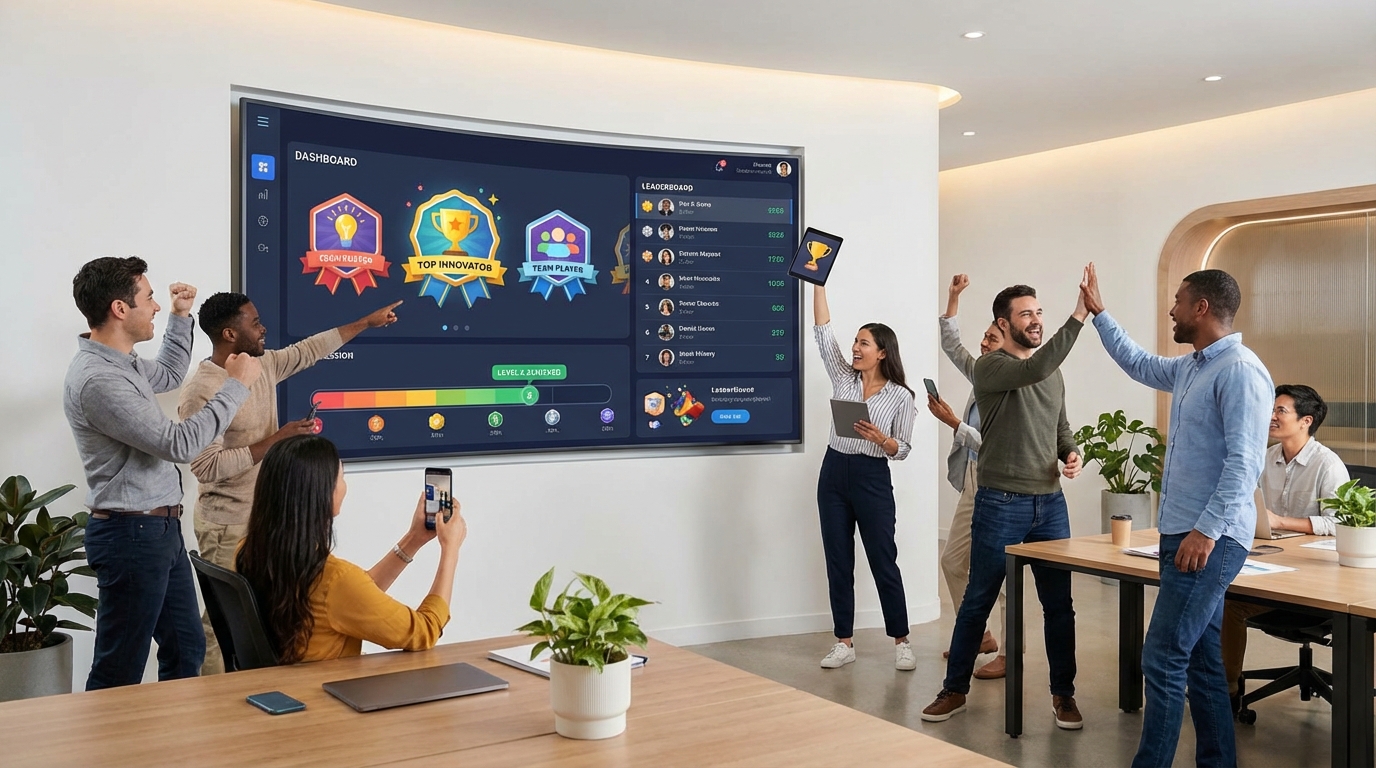
Corporate training has an engagement problem. According to the Association for Talent Development (ATD), the average completion rate for voluntary online training programs sits below 20%. Mandatory programs fare better on completion but worse on retention — employees click through to satisfy the requirement without absorbing the material. The content might be excellent. The problem is that nobody wants to engage with it.
Gamification — applying game design elements to non-game contexts — is one of the most effective tools available for closing this gap. But it is also one of the most misunderstood. Slapping a points system onto a bad training program does not make it good. Done well, however, gamification taps into fundamental human motivations and turns training from an obligation into something people voluntarily return to.
What Gamification Actually Means (and What It Does Not)
Gamification is not turning training into a video game. It is selectively applying mechanics that games use to sustain engagement — feedback loops, progression systems, social dynamics, and variable rewards — to a training context.
The distinction matters because the goal is not entertainment. The goal is behavior change: more practice, deeper engagement, better retention of skills. Every gamification element should be evaluated against that standard. If a mechanic increases engagement but does not improve learning outcomes, it is decoration, not gamification.
Research published in the Journal of Educational Psychology (Sailer & Homner, 2020) analyzed 38 studies on gamification in educational contexts and found that gamification significantly improved cognitive learning outcomes when it included elements that provided competence feedback and social comparison. Elements that only provided extrinsic rewards (points without context) showed no significant effect on learning.
The Core Mechanics That Work
Badges and Achievements
Badges work because they create visible milestones in what would otherwise be a long, undifferentiated journey. A new hire facing 40 hours of onboarding training sees an overwhelming slog. The same content broken into badge-earning modules — “Objection Handler,” “Discovery Expert,” “Closing Specialist” — creates a series of achievable goals.
Effective badge design follows three principles:
- Specific and meaningful — “Completed Module 3” is a bad badge. “Handled the budget objection in under 60 seconds with a value-anchoring response” is a badge that means something.
- Progressive — Badges should have levels. Bronze for attempting, Silver for competency, Gold for mastery. This gives high performers something to pursue and normalizes the idea that first attempts are expected to be imperfect.
- Visible to others — Badges that only the earner sees provide limited motivation. Badges displayed on a profile, shared in a team channel, or shown on a leaderboard add a social dimension that amplifies their effect.
Streaks and Daily Practice
Streaks leverage loss aversion — the psychological principle that people are more motivated to avoid losing something they have than to gain something new. A 15-day practice streak feels valuable precisely because breaking it means starting over.
The key to streak design is setting the bar low enough that maintaining the streak is always achievable. A streak that requires 30 minutes of practice daily will be broken within a week. A streak that requires completing one 5-minute simulation per day is sustainable — and over a month, that adds up to 150 minutes of focused practice that would not have happened otherwise.
Important caveat: Streaks must include grace mechanisms (one free “skip” day per week, for example). Without them, a single missed day destroys motivation entirely, which is the opposite of the intended effect.
Leaderboards
Leaderboards are the most powerful — and most dangerous — gamification element. They tap into competitive drive and social comparison, which can be intensely motivating. They can also be demoralizing if poorly implemented.
What works:
- Segmented leaderboards — Rank people within their cohort (same start date, same role, same region), not globally. A new hire competing against a 10-year veteran is not competition; it is discouragement.
- Rolling windows — Weekly or monthly leaderboards reset regularly, giving everyone a fresh start. All-time leaderboards become static and lose motivational power.
- Multiple dimensions — Leaderboards for practice volume, for improvement rate, for specific skills. This ensures that different types of effort are recognized, not just raw performance.
What fails:
- Public ranking by score alone — This humiliates low performers and provides no actionable information.
- Mandatory leaderboards with no opt-out — Some people are motivated by competition; others are demotivated by it. Making visibility optional respects this difference.
Team Challenges
Team-based gamification adds a collaborative dimension that individual mechanics lack. When a team is working toward a shared goal — “complete 100 simulations this week as a team” — peer encouragement replaces managerial nagging.
Team challenges work especially well for:
- Onboarding cohorts — New hires bonding over a shared challenge builds relationships alongside skills.
- Cross-functional teams — Pairing sales and customer success teams in a joint challenge builds mutual understanding of each other’s roles.
- Regional competitions — Healthy inter-office competition with visible progress tracking drives engagement without creating toxic dynamics, provided the emphasis is on participation rather than pure performance.
Designing a Gamification System That Lasts
The most common failure mode for gamification is the novelty cliff: engagement spikes when the system launches, then drops off as the mechanics become familiar. Avoiding this requires designing for long-term engagement from the start.
Layer mechanics progressively
Do not launch with every feature at once. Start with badges and streaks. Add leaderboards after employees have had time to build a baseline. Introduce team challenges quarterly. Each addition refreshes the system.
Tie rewards to real outcomes
Points and badges are more motivating when they connect to something tangible. This does not have to mean monetary rewards — recognition in a team meeting, a “Top Performer” designation on an internal profile, or early access to new training content all work. The principle is that achievements within the training system should have visibility outside of it.
Measure what matters
Track these metrics to evaluate whether your gamification is working:
- Voluntary practice rate — Are people training when they do not have to?
- Return frequency — How often do users come back after their first session?
- Time in deliberate practice — Not just time logged, but time spent in challenging scenarios (as opposed to repeating easy ones for points).
- Skill progression — Are gamified users improving faster than non-gamified users on the same rubrics?
If engagement metrics go up but skill metrics stay flat, your gamification is entertaining but not training. Recalibrate.
Avoid these common mistakes
- Rewarding completion over quality — If points are awarded for finishing a simulation regardless of performance, employees will rush through without learning.
- Overcomplicating the system — If employees need a tutorial to understand the gamification mechanics, the system is too complex.
- Ignoring intrinsic motivation — The best gamification enhances intrinsic motivation (mastery, autonomy, purpose) rather than replacing it with extrinsic rewards. If removing the points would make people stop training entirely, you have not built a good training program — you have built a rewards program.
Gamification and AI-Powered Training: A Natural Fit
AI-powered training simulations are particularly well-suited to gamification because they generate granular performance data on every interaction. A traditional e-learning module can only track completion and quiz scores. A simulation can track how the learner handled a specific objection, how long they took to respond, whether they asked discovery questions before pitching, and dozens of other behavioral signals.
This data richness means badges can be tied to specific behaviors rather than generic completion. A “Empathy Expert” badge earned by consistently scoring above 90% on emotional intelligence metrics in retention scenarios is far more meaningful than a “Module Complete” checkmark.
Conclusion
Gamification is not a magic fix for bad training content. But when applied thoughtfully to well-designed training programs, it solves the engagement problem that keeps even good content from being effective. The mechanics are straightforward — badges, streaks, leaderboards, team challenges — but the implementation details determine whether they drive real learning or just superficial interaction.
Roleplays includes built-in gamification features — streaks, achievements, leaderboards, and team challenges — designed specifically for simulation-based training. Every mechanic is tied to actual performance data, ensuring that engagement translates into skill development. See how it works or request a demo to experience it firsthand.
Stay in the loop
Get the latest insights on corporate training delivered to your inbox.